The Hope Diamond
- Giovanni Guazzotti
- 27 Jun, 2025
- 04 Mins read
- Gemology
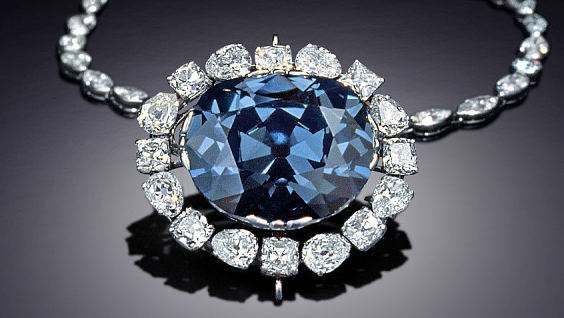
The Hope Diamond is arguably the most famous gemstone in the world — not for having sold at auction (it has not, in its current form), but for accumulating a history so dense with documented royal ownership, catastrophic misfortune, and scientific significance that it has become a reference point for everyone who works with fine gemstones professionally. Understanding its story is essential context for any serious engagement with the history of important diamonds, and its scientific profile — a 45.52-carat natural blue diamond of extraordinary purity — remains directly relevant to how we understand and value exceptional blue diamonds today.
From the Mines of Golconda to the French Crown
The stone’s documented history begins in 1666, when the French merchant and traveler Jean-Baptiste Tavernier purchased a large blue diamond in India — believed to have come from the Kollur mine in the Golconda region of what is now Andhra Pradesh, India. Tavernier described the rough as a “beautiful violet,” weighing approximately 112 carats in its original form. In 1668, he sold the stone to Louis XIV of France, who had it recut by his court jeweler to a 67.5-carat stone known as the “Tavernier Blue” and subsequently as the “Blue Diamond of the Crown” — or more famously the “French Blue.”
The French Blue was set in a ceremonial piece for the Order of the Golden Fleece and worn by Louis XIV and his successors. It passed to Louis XVI, and its trail became obscured during the French Revolution: the stone was stolen in September 1792 during the looting of the Garde-Meuble (the royal storehouse), along with much of the French Crown Jewels.
The Mystery of the Missing Decades
Following its disappearance in 1792, the French Blue dropped from documented history for twenty years — a gap that continues to generate historical and gemological debate. Under French law at the time, the statute of limitations for stolen goods was twenty years, meaning that by 1812 the stone could legally be traded or sold without legal exposure.
It is at this point that a blue diamond matching the general profile of the French Blue reappears in London, in the possession of the diamond dealer Daniel Eliason. How the stone traveled from Paris to London in the intervening decades remains unproven, though the hypothesis that it was recut to obscure its identity — reducing it from 67.5 carats to its current 45.52 carats and changing its shape — is widely accepted by gemologists and historians who have studied the physical evidence.
In 2009, researchers at the Smithsonian Institution in Washington D.C. — where the Hope Diamond has been held since 1958 — created a lead cast of the Hope Diamond and compared it to a recently discovered lead cast of the French Blue in the collections of the Muséum National d’Histoire Naturelle in Paris. The match confirmed that the Hope Diamond is a recut portion of the French Blue, resolving a historical question that had remained open for nearly two centuries.
Henry Philip Hope and the Diamond's Name
The stone acquired its current name from Henry Philip Hope (1774–1839), a London-based banker and art collector who owned it by 1839, when it appeared in a published catalog of his gem collection. Hope never disclosed how or when he acquired it, and the purchase price and provenance chain between Eliason and Hope have not been definitively established.
The stone passed through Hope’s heirs over the following decades, was sold in 1901 to meet family debts, and entered a period of rapid succession through dealers and collectors in Europe before being acquired by American jeweler Pierre Cartier in 1909. Cartier sold it in 1911 to the American socialite Evalyn Walsh McLean, who wore it frequently as a personal jewel and made it a recognized object in Washington social circles for the following four decades.
After McLean’s death in 1947, the stone was purchased by New York gem dealer Harry Winston as part of the McLean jewelry collection. Winston donated the Hope Diamond to the Smithsonian Institution in November 1958, sending it by registered mail in a plain brown package — an act of deliberate understatement that became one of the more celebrated anecdotes in the history of American jewelry.
The Gemological Profile: What Makes It Exceptional
The Hope Diamond measures 45.52 carats and is classified by the GIA as Fancy Deep Grayish-Blue — not Fancy Vivid Blue, the highest color intensity grade. This distinction is important for professionals: the stone’s fame is a function of its history, its size, and its singular provenance, not its color quality grade in the strict sense used for auction valuation.
It is a natural Type IIb diamond — containing boron and no detectable nitrogen — and it exhibits an unusual red phosphorescence under ultraviolet light, glowing orange-red for several seconds after UV exposure is removed. This phosphorescence is characteristic of Type IIb diamonds and has been confirmed by multiple scientific analyses at the Smithsonian.
The stone has been studied extensively by the GIA, the Smithsonian’s mineralogy department, and academic researchers. It represents one of the most thoroughly characterized natural diamonds in existence.
The GemmoPrice Perspective
The Hope Diamond has never been sold at public auction in its modern form, and there is no realistic prospect of it entering the market: it is held by the Smithsonian as a national treasure of the United States, attracting approximately 6 million visitors per year to the National Museum of Natural History in Washington D.C.
Its relevance to professionals, however, is real and practical. The Hope Diamond anchors the cultural and historical narrative of blue diamonds — a narrative that contributes to the collector premium that exceptional Fancy Vivid Blue diamonds command at auction. When Sotheby’s presents a 10-carat blue diamond in Geneva or Hong Kong, the depth of bidder awareness they can count on is built, in part, by a century of popular fascination with blue diamonds that begins with stories like this one.
Understanding the Hope Diamond’s history is not sentimental indulgence. It is context for the market.