Colored Stone Auction Trends 2024–2025
- Paolo Cerruti
- 13 Jun, 2025
- 04 Mins read
- Market-analysis
The 2024–2025 colored stone auction cycle has continued and in several ways intensified a trend that has been building since the post-pandemic period: the market is becoming more selective, more origin-conscious, and more dependent on gemological documentation as a precondition for competitive bidding. While headline totals across Sotheby’s, Christie’s, and Bonhams have remained broadly stable, the distribution of value within those totals has shifted — with an increasingly pronounced concentration at the top end of each category and softness in the middle market for undifferentiated material.
This pattern has implications for every participant in the market: dealers, appraisers, collectors, and auction specialists alike.
The Documentation Imperative
The most consistent trend across 2024 and into 2025 is the growing role of laboratory certification in determining whether lots attract competitive bidding. Stones presented without current reports from Gübelin, GRS, or GIA — or with older certificates that predate the expansion of origin-determination capabilities — are increasingly likely to sell at or below the low estimate, or to be passed.
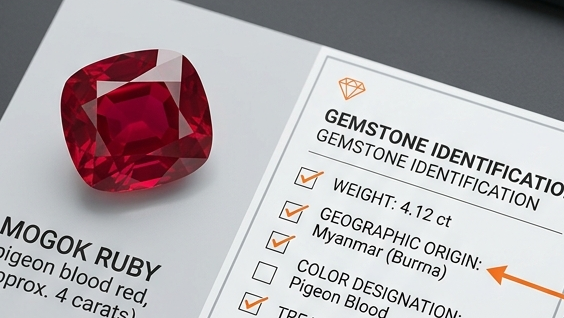
This shift is not new in principle — major laboratories have offered origin determination for rubies and sapphires for decades — but it has accelerated in practice. Buyers at major auction houses now routinely expect not just a clarity and color grade but a specific origin declaration, a treatment status assessment, and — for rubies — a color designation such as “pigeon blood” where applicable.
The practical consequence for consignors is direct: stones that would benefit from updated certification should be recertified before consignment. The cost of a Gübelin or GRS report is a rounding error relative to the value difference between a well-documented and a poorly-documented lot.
Rubies: Mogok Holds, Mozambique Finds Its Level
The ruby category in 2024–2025 has demonstrated a clearer bifurcation than at any previous point. Mogok rubies with pigeon blood certification and unheated status continue to attract strong bidding, with fine three-to-eight-carat specimens regularly achieving $200,000–$400,000 per carat at Sotheby’s and Christie’s major sales. The Myanmar sanctions have not materially reduced demand for existing inventory with documented pre-sanction provenance; if anything, they have reinforced the scarcity premium for stones already in circulation in Western markets.
Mozambican rubies — the primary commercially significant alternative origin since the Montepuez deposit’s emergence in the early 2010s — have found a more stable pricing band in the market. Top Mozambican material with GRS or Gübelin certification achieves strong results, but consistently at a discount of 50–70% to comparable Mogok stones of equivalent quality grade. This discount reflects both origin preference and the difference in geological character: Mozambican rubies generally show higher iron content and less fluorescence than Mogok material.
Sapphires: The Kashmir Premium Persists and Expands
The Kashmir sapphire premium — the multiple over comparable Burma and Ceylon stones that certified Kashmir material commands — showed no signs of compression in 2024–2025. The structural argument for this premium remains unchanged: zero new production, finite existing inventory, and growing collector awareness among buyers in Asia and the Middle East who have joined established European collectors in competing for the finest stones.
Ceylon sapphires with GRS or Gübelin “no heat” certificates have also shown appreciation, as unheated Ceylon material above five carats with strong color becomes increasingly difficult to source at the quality levels buyers expect. The “no heat” premium for Ceylon sapphires — historically modest compared to the same designation for rubies — has grown meaningfully as the supply of unheated fine material at auction has contracted.
Burma sapphires occupy an intermediate position, trading above Ceylon heat-treated material but below Kashmir across all weight ranges.
Emeralds: Colombia Dominates, Minor Origins Struggle
The emerald category continues to demonstrate the widest range of results within a single gem type of any category tracked in the major auction data. At the top end, fine Colombian emeralds — particularly with AGL or Gübelin origin reports, minimal enhancement, and strong provenance — have achieved exceptional per-carat results, building on the Rockefeller Emerald’s 2017 benchmark.
In the middle market, the proliferation of resin-treated and flux-treated material from a range of origins (Zambia, Brazil, Zimbabwe, Afghanistan) has created pricing pressure that makes undocumented or poorly-documented emerald lots increasingly difficult to place competitively. Buyers have become more sophisticated in their assessment of treatment levels and more reluctant to accept “insignificant oil” descriptions at face value without independent verification.
Fancy Colored Diamonds: Post-Argyle Supply Awareness Grows
The medium-term impact of Argyle’s November 2020 closure is beginning to show more clearly in auction data as the initial inventory accumulated before closure works through the market. Pink diamonds of Argyle origin — particularly those with Argyle Tender certificates, issued annually by Rio Tinto for its finest annual production before the mine closed — are trading at consistent premiums over non-Argyle pinks of comparable color grade.
The market for Fancy Vivid Blue diamonds remains the most structurally constrained of all colored diamond categories, with supply dependent almost entirely on the Cullinan mine’s intermittent production of gem-quality blue rough. Every significant Fancy Vivid Blue result at auction reinforces this scarcity narrative and sets a new reference point for the category.
The GemmoPrice Perspective
The 2024–2025 auction cycle confirms a structural reality that has been building in the fine gemstone market for over a decade: the market rewards documentation, penalizes ambiguity, and increasingly treats certification from the three major laboratories as a prerequisite for liquidity at the top end.
For professionals operating in this environment, access to systematic, verified auction data is more important than at any previous moment. Price differences between documented and undocumented material, between certified origins and unspecified ones, and between treatment-free and treated stones are now large enough to fundamentally alter the economics of any significant transaction.
GemmoPrice was built to provide exactly this kind of structured intelligence: auction results across all major houses, segmented by origin, weight, treatment status, and certification — the data layer that allows professionals to make informed decisions in a market where the information gap between buyers and sellers is the primary source of risk.