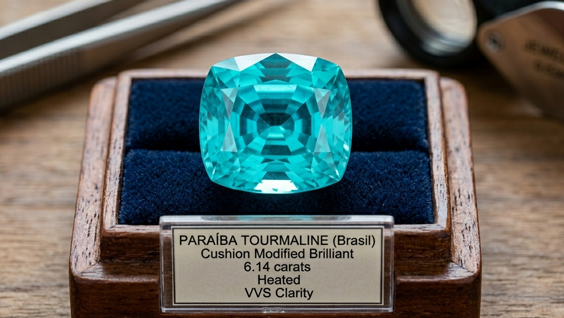
Paraíba Tourmalines
- Giovanni Guazzotti
- 02 May, 2025
- 04 Mins read
- Gemology
In the history of gemstone discoveries, few have transformed a market as rapidly and completely as the Paraíba tourmaline. Within a few years of its introduction to the trade, it had rendered every previously known tourmaline commercially secondary, introduced a new category of neon color into the lexicon of fine gemstones, and established price benchmarks that placed it alongside — and in some cases above — traditional precious stones in the collector hierarchy.
The story begins in the late 1980s in the northeastern Brazilian state of Paraíba, and it continues today in laboratories, auction rooms, and dealers’ offices on four continents.
The Discovery: Heitor Dimas Barbosa and the Mines of Paraíba
The Paraíba tourmaline owes its existence to the persistent work of a single prospector. Heitor Dimas Barbosa spent years digging through the hills of the São José da Batalha mining district in the municipality of São José de Espinharas, convinced — on the basis of his geological intuition — that something exceptional lay beneath the surface. He was right.
Beginning in 1987, Barbosa and his team began recovering tourmalines of a color unlike anything previously documented in the mineral world: an intensely saturated electric blue-green, sometimes tending toward pure blue, sometimes toward vivid green or turquoise, glowing with a luminosity that was immediately recognized as extraordinary by every dealer who saw the first stones.
The cause of this color was subsequently identified by gemologists and mineralogists: the presence of copper as a primary coloring agent, accompanied in some color ranges by manganese, within the elbaite tourmaline crystal structure. Copper-bearing tourmalines had been unknown before the Paraíba discovery. The combination of copper and manganese produces a range of colors from vivid electric blue to intense violet, all characterized by the characteristic “neon” glow that distinguishes even small or included specimens from other blue-green gemstones.
The Science Behind the Color
What makes Paraíba tourmaline’s color visually unique is its saturation relative to its lightness. Most intensely saturated gemstones — fine rubies, pigeon blood, vivid blue sapphires — achieve their color at medium-to-dark tones. Paraíba achieves extreme saturation at light-to-medium tones, producing an effect that many observers describe as fluorescent even in the absence of UV light.
This property — technically attributable to a combination of high chroma and low tone driven by the electronic absorption characteristics of the copper ion — means that even a 0.5-carat Paraíba can dominate a piece of jewelry visually in a way that no other colored stone of equivalent size can replicate.
The GIA and other leading laboratories test for copper content using laser ablation inductively coupled plasma mass spectrometry (LA-ICP-MS), a trace element analysis method that allows the quantification of copper and manganese concentrations. Stones with detectable copper are eligible for the “Paraíba-type” designation regardless of geographic origin — a ruling established through international industry consensus, formalized through the ICA (International Colored Gemstone Association) and broadly adopted by the major laboratories.
Nigerian and Mozambican Discoveries — and the Origin Question
In 2001, copper-bearing tourmalines were discovered in Nigeria, followed in 2005 by discoveries in the Mozambique province of Zambezia. These African deposits produced material visually similar to Brazilian Paraíba, and the subsequent debate — whether African material should carry the “Paraíba” name, given that the term refers to a specific Brazilian state — was resolved in favor of a mineral-chemistry-based designation rather than a geographic one.
Today, GIA, Gübelin, and GRS certify copper-bearing tourmalines from all three origins as “Paraíba tourmaline” or “Paraíba-type tourmaline,” with the origin noted separately. However, the commercial premium for Brazilian material — particularly from the original Paraíba state deposits and the later Batalha mine — remains substantially higher than for equivalent African stones.
Well-documented fine Brazilian Paraíba tourmalines of one carat or above in pure neon blue, with minimal inclusions, can achieve $10,000 to $50,000 per carat or more in the auction and dealer markets. Comparable African specimens typically trade in the $3,000–$15,000 per carat range, depending on color saturation and clarity.
Auction Performance and Market Trajectory
Paraíba tourmalines have appeared with increasing frequency in the major auction catalogs since the mid-2000s, as awareness of the category has grown among collectors and as the original Brazilian deposits have become more deeply depleted, reinforcing the scarcity premium.
The most commercially significant Paraíba lots at auction tend to be stones above three carats in pure blue or blue-green without visible inclusions — a combination that is genuinely rare given the typical crystal habit and common inclusion landscape of the material. Suites of matched stones for rings or earrings also command notable premiums.
The trajectory of the category over the past decade has been consistently upward, with Brazilian material benefiting most directly from the combination of exhausted production and growing collector awareness.
The GemmoPrice Perspective
Paraíba tourmalines represent one of the most compelling examples of a modern market discovery: a gemstone category whose commercial value was entirely unknown forty years ago and is now firmly established in the top tier of the colored stone hierarchy.
For professionals who follow this category through auction data, the key metrics are origin documentation, copper content certification, and weight range — three variables that collectively explain the majority of the price variance within the category. GemmoPrice’s dataset allows systematic tracking of Paraíba tourmaline results across houses and time, providing the reference framework that dealers and appraisers need to navigate this still-evolving market.