Spinels — The Royal Gems in Disguise
- Giovanni Guazzotti
- 30 May, 2025
- 04 Mins read
- Gemology
Few gemstones carry a more ironic history than spinel. For centuries, the finest red spinels were classified and celebrated as rubies — adorning the crowns, scepters, and regalia of the most powerful monarchies in history. The correction of this classification, once gemmological science developed the tools to distinguish between the two minerals, did not diminish the physical beauty of the stones in question. But it created a commercial anomaly that the market has spent the past two decades gradually resolving: a gem of genuine rarity, historical significance, and outstanding optical qualities that traded at a substantial discount to ruby for reasons of nomenclature rather than merit.
The Rubies That Were Not Rubies
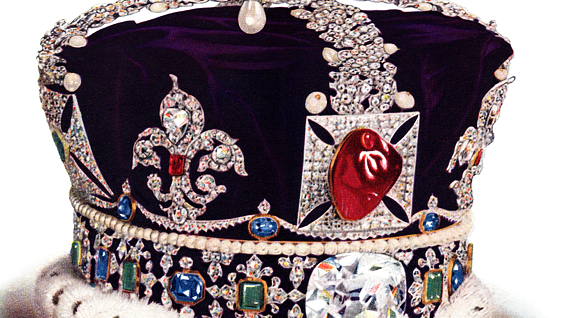
Two of the most famous “rubies” in history are spinels. The Black Prince’s Ruby — a 170-carat irregular red stone set at the front of the Imperial State Crown of the United Kingdom, worn by British monarchs for centuries — is a red spinel, not a ruby. It has been part of the British Crown Jewels since at least the fourteenth century, when it was reportedly acquired by Edward, Prince of Wales (the “Black Prince”), from Pedro of Castile in 1367 in exchange for military services.
The Timur Ruby — a 352.5-carat red spinel inscribed with the names of the Mughal emperors who owned it, including Timur himself, and presented to Queen Victoria by the East India Company in 1851 — is also a spinel. It is now part of the British Royal Collection and was documented as a spinel in 1851 by the mineralogist who examined it for Queen Victoria.
These are not isolated misattributions. The Mughal and Persian courts, the Ottoman treasury, and European royal houses all acquired stones described as rubies that modern gemological analysis has identified as spinels. The mineral distinction — spinel is MgAl₂O₄, ruby is Al₂O₃ with chromium — was not technically achievable before the development of crystallographic and spectroscopic analysis in the nineteenth and twentieth centuries.
The Geology of Fine Spinel
Spinel forms in many of the same geological environments as corundum — primarily in marble-hosted metamorphic deposits. The Mogok Valley of Myanmar, the world’s finest source of rubies, is also the world’s finest source of red spinel. Mogok red spinels — like Mogok rubies — form in iron-poor conditions that produce exceptional color purity and can show chromium-driven fluorescence comparable to the finest rubies.
Alongside Mogok, other important spinel sources include the Kuh-i-Lal mines in Tajikistan (historically the source of large red spinels for Central Asian and European courts), Sri Lanka, Vietnam, and Tanzania.
Tanzania — particularly the Mahenge region — emerged in the early 2000s as a significant source of an unusual spinel variety: intense hot pink or neon pink stones with an exceptional saturation reminiscent of Paraíba tourmalines. These “Mahenge spinels,” sometimes informally called “Jedi spinels” for the intensity of their color, attracted immediate attention from specialist collectors and dealers and have been the subject of competitive auction bidding since their introduction.
The Market Revaluation of Spinel
The commercial revaluation of spinel as an independent gem category — rather than a ruby substitute — has been underway since approximately 2010, driven by several converging factors.
First, the growing sophistication of the international collector base has supported appreciation for gemstones valued on their own terms rather than by comparison to traditional categories. Second, the leading gemological laboratories — GIA, Gübelin, GRS — expanded their certification and origin-determination services for spinel, providing the documentation infrastructure needed to support premium pricing. Third, the GIA and the American Gem Trade Association (AGTA) formally recognized red spinel as a secondary birthstone for August in 2016, alongside peridot and sardonyx — a designation that substantially increased public awareness of the gem.
The result has been visible in auction data. Fine Mogok red spinels with GRS or Gübelin certification now regularly achieve $10,000–$30,000 per carat in the three-to-five-carat range at major sales — figures that would have been exceptional a decade ago and are now increasingly standard for top material.
Spinel Versus Ruby: The Remaining Gap and Its Logic
Despite its appreciation, fine spinel still trades at a discount to equivalent Mogok rubies — a gap that reflects market convention more than gemological fundamentals. Ruby carries centuries of cultural embeddedness as the most valuable red stone; spinel, despite its royal history, must build its premium from a more recent starting point.
This gap also represents an opportunity recognized by specialist collectors. Acquiring fine Mogok red spinel with GRS “Mogok, Myanmar” documentation at $20,000 per carat represents a different risk/return profile than acquiring a comparable ruby at $150,000 per carat. Whether that gap converges over time — as it has partially done already — is a question that only sustained market data can answer.
The GemmoPrice Perspective
Spinel is one of the most instructive categories in the GemmoPrice dataset: a stone whose auction trajectory has been clearly upward over the past fifteen years, driven by documentation improvements, certification availability, and collector education, but which still presents pricing anomalies relative to ruby that suggest further convergence is possible.
For professionals tracking colored stones at auction, spinel’s performance — particularly Mogok red and Mahenge pink material — provides a real-time view of how market awareness translates into price movement in a category transitioning from niche to mainstream collector interest.